

In 2026, stablecoins are expanding beyond their role as trading instruments for virtual assets into cross-border payments, financial settlement, and digital financial infrastructure. According to DefiLlama, the global stablecoin market capitalization has surpassed US$300 billion. At the same time, stablecoins are becoming increasingly connected to the existing financial system.
Regulation is a key force behind this shift. The U.S. has passed the GENIUS Act, while the CLARITY Act continues to advance through the legislative process. Taiwan’s Legislative Yuan passed the Virtual Asset Services Act on June 30, 2026, laying the legal foundation for the development of the stablecoin industry. In September 2026, the Monetary Authority of Singapore (MAS) launched a public consultation on proposed amendments to the Payment Services Act, a step toward codifying its stablecoin regulatory framework into law. Stablecoins are steadily becoming part of mainstream finance.
Recognizing the potential of stablecoins and their applications, the blockchain-enabled financial institution XREX Group has hosted the Stablecoin Summit in Singapore for four consecutive years since 2023. The fourth edition, Stablecoin Summit 2026, took place on October 8 at Andaz Singapore. It brought together more than 30 international speakers and over 600 attendees, including stablecoin issuers, banks, payment service providers, asset managers, and representatives from regulatory authorities. This year’s summit focused on the next phase of stablecoins as they evolve into financial infrastructure.
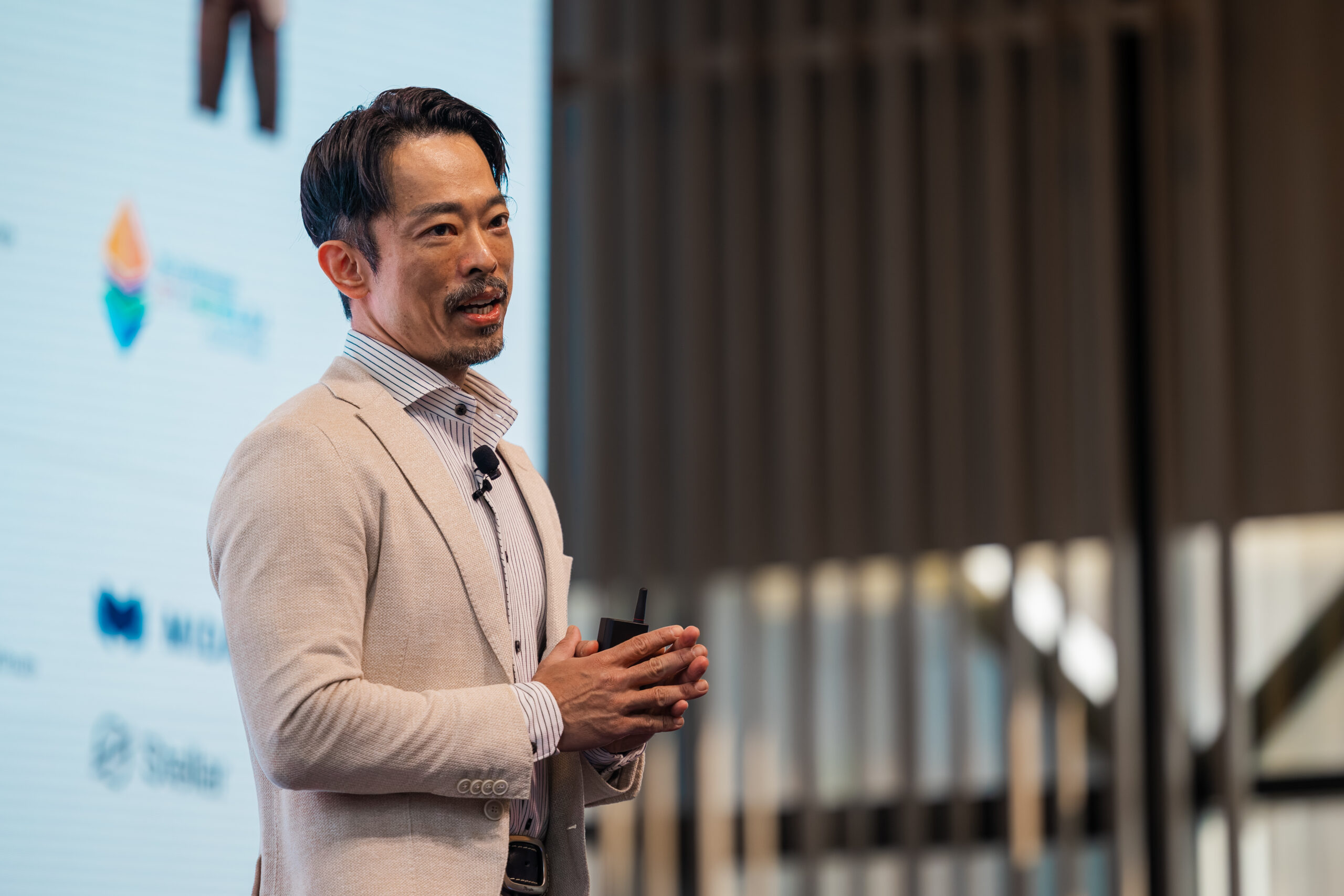
In his opening keynote at Stablecoin Summit 2026, Wayne Huang, Co-founder and Group CEO of XREX, spoke on “Stablecoin Mass Adoption: The Hard Work Ahead.” This year’s talk built on the ideas explored in last year’s keynote, “Stablecoins as Digital Bearer Money.”
He began with the friction stablecoins face when off-ramping to fiat, and the difference between “moving value” and “payment.” Using education and AI in healthcare as examples, he explained why new technologies must be integrated into existing systems, rather than building entirely separate systems. He concluded with two game changers for accelerating the integration of blockchain and traditional finance: new stablecoin regulatory frameworks and agentic operational efficiency.
Below is the transcript of Wayne’s keynote at Stablecoin Summit 2026.

All right, first talk. Thanks again for having me, for coming in so early in the morning. All right, let’s go where we left off last year. What was our talk last year at the summit?
Last year, we looked into the core of stablecoin innovation. And we said, when we invented stablecoins, what was the core innovation? At that time, we asked the question: what if we didn’t digitize money using closed-loop ledgers? What if we tried to digitize paper bills? Paper bills are bearer instruments. They’re permissionless. You can hold them using a bag, using your hands.
You don’t need anybody’s permission. You don’t need a bank account. So, paper bills offer great financial sovereignty. So, what if we try to digitize paper bills? And at the time, we asked, well, what’s the best technology to do that, to digitize and mint digital bills online? Of course, it’s the blockchain. So, last year we established that stablecoins are digitized paper bills minted on decentralized ledgers.
So, what happens when we off-ramp from stablecoins to fiat? It’s very much like us taking lots of bags of cash, walking into the bank, and trying to deposit that bunch of cash at the bank. So, when digitized dollars on decentralized ledgers try to enter the existing financial system, what would happen? Or when money on open loops tries to enter closed-loop systems, there are unavoidable friction and choke points.
Stablecoins on open networks grew rapidly in countries with weak currencies and US dollar shortage issues. They’re similar to digital paper cash, as we established. There’s no KYC, no account issuance needed. So, the rapid adoption proved that permissionless access accelerates financial inclusion.
The challenge today is when this type of money tries to enter the established payment system, which are closed loops, and there is just high friction. Why? The friction is all because of compliance. Well, the existing payment systems aren’t just about compliance. Hey, payment involves a lot more than simply moving value. In Web3, we said, well, what’s the big deal? You have a Web3 wallet. I have a Web3 wallet. I sent my stablecoins to you. It’s paid. It’s done. It’s so simple and easy. No, that’s moving value, that’s not payment.
Let’s look at important fiat payment features in consumer-to-business payments. For consumers, we have dispute management, right? Your refunds, chargebacks, and reversals. We’ve got fraud and cybersecurity protection. We’ve got credits and installments. And for merchants, we have acceptance and fraud protection, default handling and collection, reconciliation, accounting, and tax filings. And finally, merchant financing.
In B2B payments, we’ve got conditional payment and commercial assurance. Think about escrows, letters of credit, cash guarantees, exceptions, returns, recalls, and dispute remediation, tax refund. And reporting, very important. Every country subsidizes, right? So, as an importer, manufacturer, brand, if I’m using stablecoins and I’m exporting and I can’t get refunds, it’s a big problem.
Supply chain financing. The world economy runs on finance and credit. And stablecoins as standalone without tapping into this system is minimized. Stablecoin payments incorporate very little of these features today. So, the financial inclusion job, our job, is not yet done.
Job’s not done. So, what’s the job? What’s our job? One, retain the permissionless and inclusivity of stablecoins. Two, integrate stablecoin payments into the existing payment systems. Three, recognize that a compliant payment system needn’t to be completely closed loop. So, why is it important to integrate stablecoins into existing systems? Why is it so important? Well, let’s look at history.
I grew up in a time without the internet, so I learned everything from the traditional education system. The internet came about, was introduced when I was already in university. But today, I get most of my knowledge from the internet, right? So, is it important that our children still stick to the traditional education system? Can our children grow up outside of the traditional education system? Let’s say we homeschool them, right? Can we do that?
Not all internet knowledge has been integrated into the existing system. And if our learning is predominantly from knowledge from the internet, do we still need the existing education system? Well, from personal experience, I, as a Taiwanese, if I want to come here to work in Singapore or work elsewhere, or work in the US or Japan, I need a work visa. And you know what’s very important when I try to apply for that work visa? It’s my college degree, or university degree, right?
Or for people getting their first job, it doesn’t matter how much you know, how much you’ve learned. Really, your degree is still gonna matter. Your education is gonna matter. So it’s really hard for our children today to really grow up outside of the existing [education] system. So there’s been a lot of work here in Singapore, for example, to incorporate internet knowledge into the existing [education] system because our children today still need that system.
AI. Past two years, I have personally benefited tremendously from AI’s healthcare knowledge. I was able to use AI and discover quite a few of my personal genetic vulnerabilities and apply early medication for longevity. But it was very difficult for me because such AI knowledge has not been integrated into the current medical system. So, my doctors were not able to use the knowledge generated by AI to prescribe medication to me.
What I have to do today is one, in Taiwan, if I can get a prescription, I’m still not covered by insurance, so I pay for myself. A lot of times, I cannot get that prescription in Taiwan, so I come to Singapore, I get a prescription, and I pay for myself. I told my brother because he has the same genetic defects, and he is able to get himself fully insured with the same medication in the US because the US system has integrated AI faster, right?
And so, same thing today, yes, AI is generating a lot of help in healthcare, but we cannot operate outside of the existing medical system, and therefore, there’s been a lot of effort to try to integrate AI capabilities into the current medical system. Because we cannot live right now outside of that existing system.
Similarly, stablecoins as digital cash cannot stand alone outside of the existing financial system. Why? We just covered it. The existing financial system, for example, the existing payment systems provide dispute management, tax filing and returns, and audits that’s unavailable, that’s not inherently built into stablecoin transactions.
And the current finance system provides, as we talked about, consumer credit, merchant financing, and supply chain finance. The world economy runs on finance and credit. So, we need to integrate stablecoin transactions into the existing financial systems. And we need to do that hard work. So, how to get the job done? In doing the job, we asked what could be game changers in bridging stablecoin payments into existing systems. There’s one game changer, and that’s new stablecoin regulatory frameworks.
XREX has been operating here in Singapore under the Major Payment Institution license. The Payment Services Act passed Singapore’s parliament in 2020, and in 2021 it was amended with the digital payment token coverage, which allows us to facilitate cross-border B2B payments both in fiat currency and also in stablecoins. The GENIUS Act is another very similar accelerator.(Singapore’s Parliament passed the Payment Services Act in January 2019, and the Act took effect in January 2020.)
Other than these new regulatory frameworks, there’s another game changer. If we look closely at the friction, the open-to-closed-loop bridging challenge heavily involves operations, what we call the OPEX scaling nightmare.
And that is, as any payment or finance service usage grows, so does operational complexity and headcount. And we’re talking about compliance analysts, L1, L2 investigators, risk controllers, reconciliation accountants. And this is why TradFi systems are costly, slow, and often not 24/7.
So, what’s the game changer, the accelerator? It’s agentic operational efficiency. We feel that the operational backbone needs to shift from human-centric workflows to agentic operational models. Equipped with domain-specific knowledge, AI agents should execute core workflows with human supervision and escalations and approvals.
This requires an AI-native financial service operating system, what we call FSOS, that builds agentic efficiency into the operation model. Supports governed human-in-the-loop architecture and model risk governance, enables AI-assisted KYC and CDD AML investigations, suspicious transaction report generation, and exception management. And where every AI-assisted recommendation and action is traceable to supporting evidence and approval history.
All right, so by leveraging these new regulatory frameworks and agentic operational efficiency, we can accelerate the integration of blockchain and traditional finance. It’s very hard work, but it needs to be done. And in talking about hard work, I share with you two quotes. Ben Horowitz of a16z: “Hard things are hard because there are no easy answers or recipes.” And by Jeff Bezos: “You earn trust slowly over time by doing hard things well.”
Permissionless and programmable money, atomic settlement, agentic commerce, mass adoption at scale. Let’s get the job done. Thank you.
About XREX Group
XREX Group is a blockchain-enabled financial institution working with banks, regulators, and users to redefine banking together. We provide services to businesses in or dealing with emerging markets, and novice-friendly financial services to individuals worldwide.
Founded in 2018, XREX Group offers a full suite of services such as digital asset custody, wallet, cross-border payment, fiat-crypto conversion, cryptocurrency exchange, and fiat currency on-off ramps.
Sharing the social responsibility of financial inclusion, XREX leverages blockchain technologies to further financial participation, access, and education.
XREX Singapore operates under the Major Payment Institution (MPI) license issued by the Monetary Authority of Singapore (MAS). XREX Taiwan is a regulated VASP that completed its Compliance Declaration on Anti-Money Laundering (AML) with Taiwan’s Financial Supervisory Commission (FSC) in March 2022. It passed its AML registration with the FSC in September 2025, becoming one of ten approved VASPs.